
SuperBankRatings: An Andersen Consulting Cambodia’s Research and Rating Platform

Redefining Financial Transparency in Cambodia

SuperBankRatings’, developed under Andersen Consulting Cambodia, represents a next-generation research and rating platform designed to elevate transparency, governance, and performance benchmarking across Cambodia’s financial services sector.

Positioned as Cambodia’s premier independent banking research and rating provider, the platform delivers:

  • Objective, data-driven institutional assessments
  • Comparative benchmarking across the sector
  • Strategic insights for banks, regulators, investors, and consumers

Its core mission is to close the information gap between financial institutions and stakeholders, enabling better decision-making, improved outcomes, and stronger financial systems.


What is SuperBankRatings’? …  A Strategic Intelligence Platform

SuperBankRatings’ is a multi-layered research, analytics, and benchmarking ecosystem.

  1. Core Positioning
  • Independent research & ratings
  • Performance benchmarking platform
  • Financial education and insight provider
  • Market discipline and transparency engine

Unlike credit ratings:

  • Credit ratings – Measure default risk
  • SuperBankRatings – Measures institutional quality, execution capability, governance, and resilience

The SuperBankRatings’ framework applies structured, methodology-driven analysis to deliver rigorous benchmarking, enhanced transparency, and meaningful sector-wide insight. In doing so, it serves as a powerful complement to Andersen Consulting Cambodia’s credit and bond ratings, strengthening market discipline and institutional accountability across the financial services ecosystem. This distinction is particularly critical in emerging markets such as Cambodia, where qualitative institutional strength is often under-analysed.

  1. Methodology … The Engine Behind the Platform

SuperBankRatings’ operates on a comprehensive 11-pillar framework, integrating:

  • Financial strength
  • Governance
  • Risk management
  • Technology & innovation
  • ESG and sustainability

The framework combines:

  • Quantitative metrics
  • Qualitative institutional assessments
  • Peer benchmarking analysis

This methodology is time-tested and globally proven, having shaped:

  • Australia’s superannuation system
  • Hong Kong’s pension ecosystem

Both of which are now considered industry benchmarks.

  1. Products Developed by SuperBankRatings’

(Full Platform Coverage – Based on Official Services & Outputs)

SuperBankRatings’ is not a single product, it is a comprehensive ecosystem of interconnected research, ratings, benchmarking, and engagement tools.

3.1 Core Research & Diagnostic Products

i/ Bank Health Check

A deep-dive institutional diagnostic tool evaluating:

  • Financial performance
  • Strategy and operations
  • Technology infrastructure
  • Risk management and compliance

It provides:

  • Full operational diagnosis
  • Strategic recommendations
  • Forward-looking risk insights

Defined as a tool that evaluates “all aspects of a financial institution’s structure and performance”

ii/  Benchmark Reports

A comparative performance assessment tool enabling financial institution’s to:

  • Measure performance against peers
  • Identify strengths and weaknesses
  • Align with industry standards

Described as an “indispensable tool … to assess market position and performance”

iii/ Form Guides (Signature Product)

A 2-page high-impact institutional snapshot, unique in the financial services’ sector.

Features:

  • Key financial metrics
  • Peer benchmarking
  • Visual dashboards & scorecards
  • Strengths & weaknesses summary
  • Forward-looking indicators

Impact:

  • Simplifies complex banking data
  • Enhances decision-making for investors, regulators, and consumers
  • Improves transparency and governance

Designed to “condense complex data into clear, comparable insights”

3.2 National & Sector Benchmarking Platforms

iv/ SuperBank “Highway” Platform

A flagship digital benchmarking ecosystem providing:

  • Top 10 bank rankings across 3 asset tiers
  • Ratings across all 11 key pillars
  • Peer comparisons across categories

Positioned as Cambodia’s centralised bank ranking and benchmarking hub

v/ SuperPower Index Reports

A multi-report series covering all 11 rating dimensions, including:

  • Financial Strength & Performance Index
  • Governance Index
  • Risk & Liquidity Index
  • ESG & Sustainability Index
  • Technology & Innovation Index

These reports:

  • Rank institutions nationally
  • Provide sector-wide insights
  • Offer strategic recommendations

vi/ MDI & MFI SuperPower Index

Extends the framework beyond banks to:

  • Microfinance institutions (MFIs)
  • Minority depository institutions (MDIs)

Focus:

  • Institutional resilience
  • Funding stability
  • Risk discipline
  • ESG and technology readiness

3.3 Ratings, Awards & Recognition Platform

vii/ Ratings & Awards Framework

A market discipline mechanism that:

  • Recognises top-performing institutions
  • Incentivises better governance and performance
  • Drives competition within the sector

Proven over 20+ years to improve industry standards and transparency

3.4 Research, Insights & Thought Leadership

viii/ Research Products & Publications

SuperBankRatings’ produces:

  • Market analysis reports
  • Sector insights
  • Trend reports
  • Policy-aligned whitepapers

Designed to deliver “in-depth, detailed research and expert opinions”

ix/ News & Industry Thought Leadership

Regular publications covering:

  • ESG trends
  • Digital banking evolution
  • Monetary developments

These insights:

  • Shape market narratives
  • Influence policy thinking
  • Educate stakeholders

3.5 Market Engagement & Ecosystem Development

x/ Events & Industry Engagement

SuperBankRatings’ hosts:

  • Industry forums
  • Workshops
  • Conferences
  • Awards events

Designed to “keep stakeholders informed, inspired, and connected”

xi/ SuperBankRatings’ Endorsed Products

A curated endorsement framework for:

  • Financial products
  • Services aligned with resilience and customer outcomes

Focused on improving “financial resilience and long-term well-being outcomes”

xii/ Financial Education (Money Tree Initiative)

An education platform aimed at:

  • Improving financial literacy
  • Enhancing consumer understanding
  • Supporting long-term wealth outcomes

 3.6 Integrated Platform Summary

SuperBankRatings’ is therefore a multi-layered ecosystem, comprising:

3.6.1 Diagnostic – Health Check

3.6.2 Benchmarking – Benchmark Reports, SuperPower Index

3.6.3 Intelligence – Research Reports, News

3.6.4 Simplification – Form Guides

3.6.5 Market Discipline – Ratings & Awards

3.6.6 Engagement – Events 

3.6.7 Education – Money Tree

3.6.8 Platform – SuperBank Highway

  1. Impact … Shaping Financial Systems (Global to Cambodia)

The methodology behind SuperBankRatings’ has already:

  • Defined benchmarks in Australia and Hong Kong
  • Improved governance and disclosure standards
  • Driven competition and innovation
  • Increased investor confidence

In Cambodia, it is expected to:

  • Enhance transparency across banks, MFIs, and corporates
  • Strengthen regulatory alignment
  • Improve risk management frameworks
  • Attract international investment

Ratings frameworks are proven to “drive transparency, accountability, and stability”

Andersen Consulting Cambodia … Positioned to Lead

Andersen Consulting Cambodia is uniquely positioned due to:

  • Regional expertise across APAC
  • Proven ratings and research pedigree
  • Independence and credibility
  • Integration of ESG, advisory, and ratings

This enables delivery of:

  • Institutional-grade financial intelligence
  • Regulator-aligned frameworks
  • Investor-ready analytics


 The Future … A Transparent Financial Ecosystem

The future of Cambodia’s financial sector will be driven by:

  • Transparency
  • Benchmarking discipline
  • ESG integration
  • Digital transformation
  • Data-driven decision-making

SuperBankRatings’ research and rating platform is positioned at the centre of this evolution.

 A Structural Shift

SuperBankRatings is not just a platform, it is a market-shaping infrastructure.

It transforms:

  • Data – Insight
  • Institutions – Benchmarked entities
  • Markets – Transparent ecosystems

And in doing so, it establishes:

A new standard for financial intelligence, governance, and trust in Cambodia and the wider region.


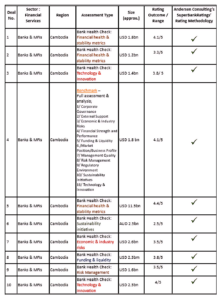
Selected Andersen Consulting Cambodia’s SuperBankRatings’ Financial Services Research & Rating Projects
Disclaimer

This article is prepared for informational purposes only and reflects the independent analytical capabilities of Andersen Consulting Cambodia as a fully accredited credit rating agency and provider of financial services research and ratings under its SuperBankRatings product framework.

All ratings and assessments are based on information available at the time of analysis and are subject to ongoing surveillance and review.

Enquiries:

K H Wee-Oon

Chief Research & Rating Officer

Andersen Consulting Cambodia

E: wee-oon.kwanghwee@kh.Andersen.com

Telegram: @KHWeeOon

What is an ESG Rating? Why Cambodian Businesses Must Prepare Now

An ESG rating evaluates how well an organisation manages risks and opportunities related to environmental, social, and governance factors.

These ratings provide stakeholders with an independent assessment of how responsibly and sustainably an organisation operates.

The three (3) pillars include:

  • Pillar 1 – Environmental

This evaluates how a company manages its environmental footprint and climate impact.

Typical factors include:

  • Carbon emissions and climate strategy
  • Energy usage and renewable energy adoption
  • Waste management and pollution control
  • Natural resource protection
  • Climate resilience and transition planning


  • Pillar 2 – Social

This assesses how an organisation manages relationships with employees, customers, and communities.

Examples include:

  • Labour standards and worker welfare
  • Human rights policies
  • Customer protection and product responsibility
  • Community engagement
  • Diversity and inclusion


  • Pillar 3 – Governance

Governance evaluates the integrity and effectiveness of corporate leadership and decision-making structures.

Key considerations include:

  • Board independence and oversight
  • Transparency and disclosure practices
  • Risk management frameworks
  • Anti-corruption policies
  • Executive accountability

Globally, ESG investing has grown significantly, with sustainable investment strategies managing over USD 30 trillion in assets worldwide, highlighting the increasing importance of ESG data and ratings in financial decision-making.


Why Environmental, Social and Governance (ESG) Standards Are Becoming Essential for Businesses in Cambodia

As Cambodia’s economy matures and integrates more deeply into regional and global capital markets, Environmental, Social and Governance (ESG) standards are rapidly emerging as a critical component of corporate transparency, risk management, and investor confidence.

Across Asia and globally, ESG is no longer viewed as a voluntary corporate responsibility initiative. It is increasingly becoming a regulatory expectation, a financing prerequisite, and a strategic management tool for corporations, banks, and financial institutions.

Cambodia is now entering this phase of transition.


ESG Compliance and Disclosure in Cambodia

Cambodia has begun developing a regulatory framework for ESG and sustainable finance.

One of the most significant developments is the ESG Disclosure Prakas issued by the Securities and Exchange Regulator of Cambodia (SERC).

Under this regulation:

  • Companies listed on the Cambodia Securities Exchange (CSX) will be required to publish ESG disclosures.
  • Mandatory reporting includes environmental and social risks, impacts, and mitigation strategies.
  • Companies must report key sustainability metrics such as greenhouse gas emissions and social impact policies.

These disclosures are expected to become effective from May 2026, although voluntary reporting is encouraged in advance.

The Cambodian government is also working with international partners to expand sustainable finance frameworks, including ESG guidelines, climate-related financing mechanisms, and green investment strategies.

Why ESG Ratings Are Becoming Necessary in Cambodia

Several structural forces are driving the rapid adoption of ESG standards in the Kingdom.

  1. Access to International Capital

International investors increasingly require ESG disclosures before committing capital.

Without ESG reporting, Cambodian companies may face challenges accessing:

  • International bond markets
  • Sustainable investment funds
  • Development finance institutions
  1. Growth of Green and Sustainable Bonds

Cambodia is actively promoting green bond issuance to finance climate-related projects such as renewable energy, sustainable infrastructure, and energy efficiency.

Programs supported by regulators and development institutions aim to accelerate sustainable bond issuance and align Cambodian issuers with international ESG standards.

  1. Climate and Environmental Risks

Cambodia faces increasing exposure to climate risks such as flooding and drought.

These risks can significantly affect economic growth and financial stability, making ESG risk management an important tool for financial institutions and corporates.

  1. ASEAN Sustainable Finance Integration

Cambodia is part of the broader ASEAN sustainable finance ecosystem.

Regional initiatives such as the ASEAN Sustainable Finance Taxonomy and ESG disclosure frameworks are designed to standardize sustainability reporting across Southeast Asia and improve transparency for investors.


Which Entities Are Affected by ESG Compliance?

Currently, ESG compliance requirements are primarily focused on capital markets participants, but the scope will expand over time.

  • Entities Currently Affected

– Listed Companies

Companies listed on the Cambodia Securities Exchange must begin ESG disclosures under the SERC framework.

– Bond Issuers

Corporations issuing green, social, or sustainability bonds must demonstrate ESG compliance and reporting to investors.

– Banks and Financial Institutions

Financial institutions are increasingly integrating ESG risk into lending and investment decisions through sustainable finance principles.

– Large Corporations and Multinationals

Companies operating within international supply chains must comply with ESG expectations imposed by global partners and investors.

  • Entities Likely to Be Affected in the Future

Over the next 3–5 years, ESG requirements are expected to extend to:

  • Commercial banks
  • Microfinance institutions
  • Insurance companies
  • State-owned enterprises
  • Infrastructure developers
  • Property developers
  • Energy and mining companies
  • Export-oriented manufacturers
  • Large family-owned conglomerates

In addition, SMEs participating in international supply chains will increasingly need to disclose ESG information to meet procurement and financing requirements.

The Role of Regulators and Stakeholders

Several Cambodian regulators and institutions are involved in advancing ESG and sustainable finance.

Key stakeholders include:

Securities and Exchange Regulator of Cambodia (SERC)

  • ESG disclosure regulations
  • Sustainable bond frameworks
  • Capital market transparency

National Bank of Cambodia (NBC)

  • Sustainable banking initiatives
  • Climate finance development
  • Financial sector risk management

Ministry of Economy and Finance (MEF)

  • Fiscal policy and sovereign sustainability strategies

Ministry of Environment (MoE)

  • Environmental regulation and climate policy

International Development Institutions

Partners supporting Cambodia’s ESG transition include:

  • International Finance Corporation (IFC)
  • Asian Development Bank (ADB)
  • World Bank
  • UN agencies

These institutions help develop policy frameworks, capacity building, and sustainable finance programs in Cambodia.

Why Preparation for ESG Matters Now

Although ESG reporting requirements are still evolving in Cambodia, early preparation is essential.

Companies that begin ESG preparation early will benefit from:

  • Improved investor credibility
  • Easier access to financing
  • Stronger corporate governance structures
  • Reduced regulatory risks
  • Enhanced brand reputation

Conversely, companies that delay preparation may face higher costs and greater regulatory pressure in the future.

Andersen Consulting Cambodia: Spearheading ESG Ratings and Compliance

As Cambodia’s financial markets develop, independent ESG assessment and ratings will play a crucial role in strengthening transparency and investor confidence.

Andersen Consulting Cambodia is at the forefront of this development as an accredited Credit Rating Agency (CRA) in the Kingdom.

With a combined international and local team, and 25+ years-experience across the region, Andersen brings extensive expertise in:

  • Credit and bond ratings
  • Sustainable finance analysis
  • ESG risk evaluation
  • Corporate governance assessments
  • Financial sector research

By integrating ESG analysis within credit and financial ratings frameworks, Andersen helps:

  • Corporates prepare for ESG disclosures
  • Financial institutions manage sustainability risks
  • Bond issuers meet international investor expectations
  • Regulators strengthen market transparency

This capability is particularly important as Cambodia moves toward a more sophisticated capital market ecosystem aligned with ASEAN and international standards.

The Strategic Importance of ESG for Cambodia

The rise of ESG is not simply a regulatory trend, it represents a structural transformation in how economies and financial systems operate.

For Cambodia, ESG integration will help:

  • Strengthen financial sector resilience
  • Attract long-term international investment
  • Support sustainable economic growth
  • Improve environmental protection and climate resilience
  • Enhance corporate governance and transparency

Ultimately, ESG ratings and compliance are becoming a foundational component of Cambodia’s financial and economic modernization

Disclaimer

This article is prepared for informational purposes only and reflects the independent analytical capabilities of Andersen Consulting Cambodia as a fully accredited credit rating agency and provider of financial services research and ratings under its SuperBankRatings product framework.

All ratings and assessments are based on information available at the time of analysis and are subject to ongoing surveillance and review.

Enquiries:

K H Wee-Oon

Chief Research & Rating Officer

Andersen Consulting Cambodia

E: wee-oon.kwanghwee@kh.Andersen.com

Telegram: @KHWeeOon